RocketSim: Benchmarking Reinforcement-Learning Hover Control of a Reusable Booster
Faculty of Computer and Information Science (FRI), University of Ljubljana, Slovenia · *corresponding author
29th International Multiconference Information Society (IS 2026), Ljubljana, 5–9 October 2026 · Vol. 1, pp. 64–67 · DOI 10.70314/is.2026.skui.80
Abstract. Reinforcement learning (RL) is increasingly proposed for controlling reusable rockets, but existing studies address landing, where touchdown gives the learner a clear goal. We ask what happens when the task is instead to hover at a fixed height, where no such goal event exists. We built RocketSim, a configurable rocket-control simulator in the Unity game engine, and trained proximal policy optimisation (PPO) to release a booster at 80 m and hold it at 30 m. The agent learned to stay upright, stay over the pad and fly until its tanks ran dry, but not to hold the commanded height: with nothing changed but the random seed, its final altitude ranged from the ground to the ceiling. Two causes are responsible. First, the reward ranks obedient flight highest, since a hand-written controller that follows the command scores 23% more under it, but far from the target it barely changes with height, so PPO has no gradient to follow. Second, below 33.6 t the engine cannot throttle under its 39% floor, so for the last 55% of the burn no setting holds altitude. We tried to repair both: three reshaped objectives cut the mean final error from 36 to 6 m but still strand one seed in five, and a vehicle that can throttle down sinks instead. Hover has to be fixed in the reward and in the vehicle together.
Keywords: reinforcement learning, reusable launch vehicle, hover control, benchmark, reward shaping, Unity ML-Agents, PPO
The short version
Landing is an easy task to reward: the flight ends at touchdown and success is a clear event. Hovering at a set height has no such event. The agent is paid a little every second for being close to the target, and nothing ends the flight except a failure. We built a simulator to see what PPO does with that task, and the answer is that it learns almost everything except the one thing that was asked.
RocketSim
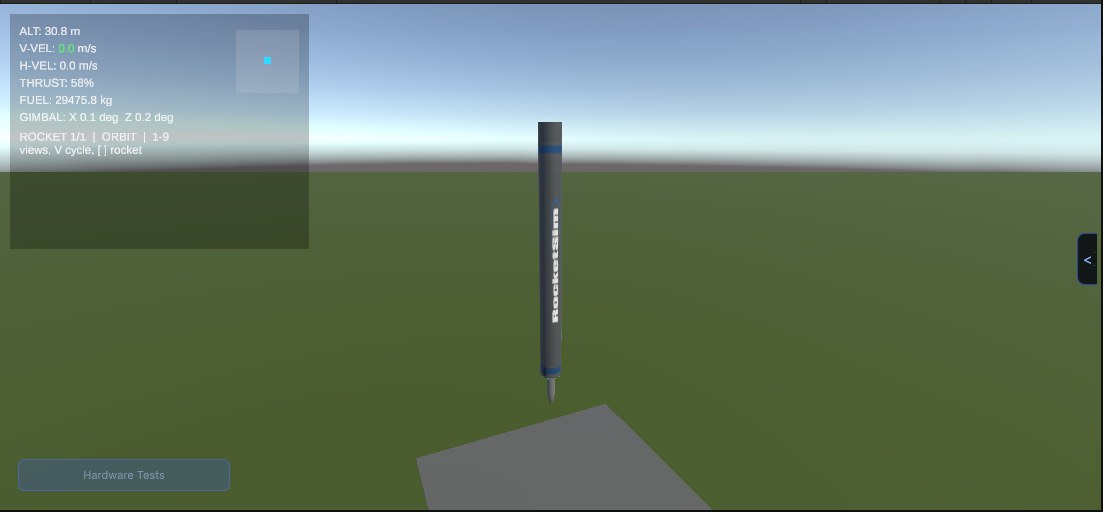
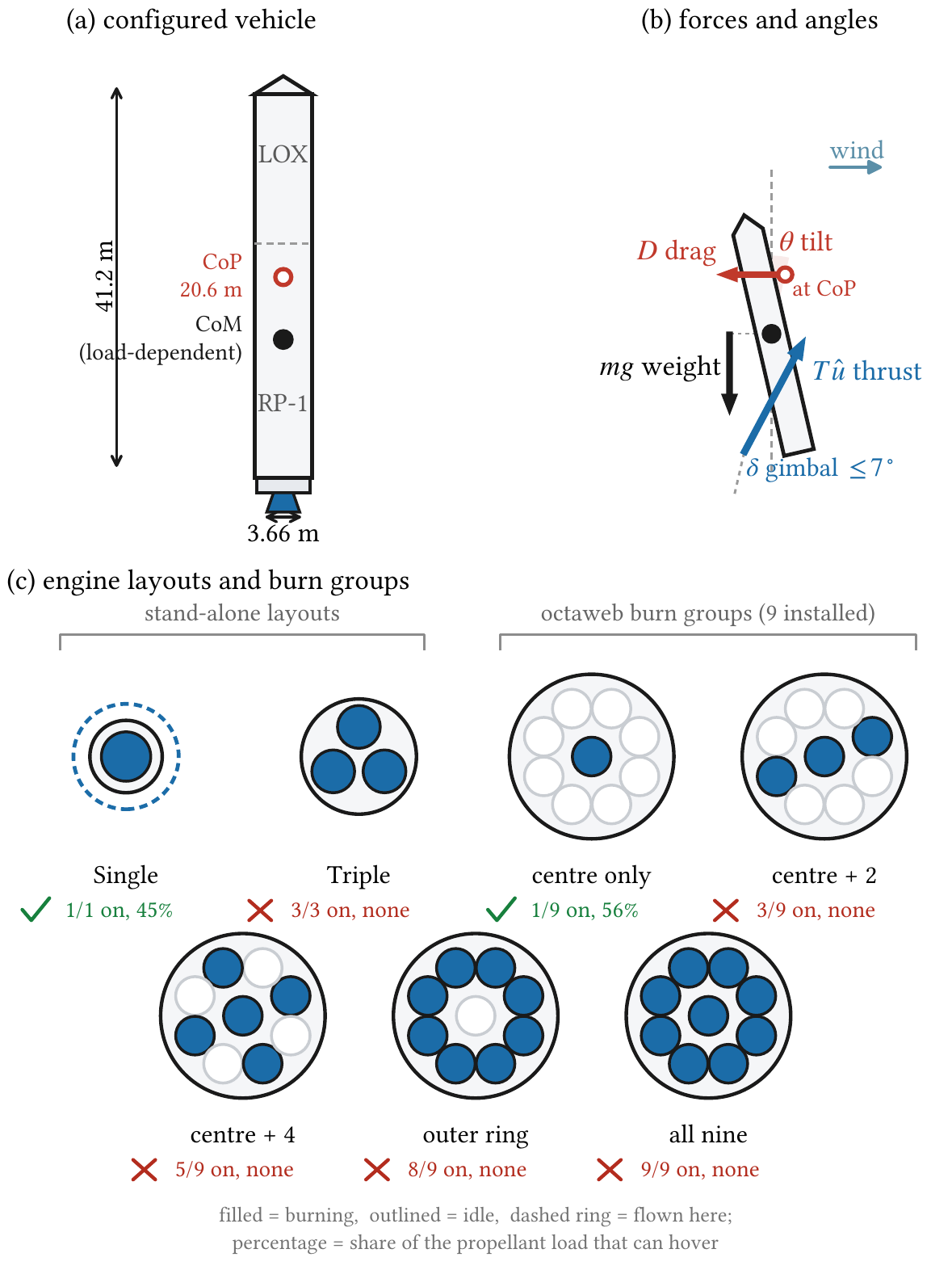
RocketSim is a rocket-control simulator built in the Unity game engine. It models the body, engine, throttle and gimbal limits, fuel use, atmosphere and drag. It defines tasks such as hover together with their reward functions and safety limits, and it connects to Unity ML-Agents, whose PPO implementation trains the agent. Every setting is recorded and frozen before a run starts, so any run can be reproduced exactly. The configured vehicle is a 41.2 m, 57.4 t booster with a single 845 kN engine that can throttle between 39% and 100%.
What the agent learns, and what it does not
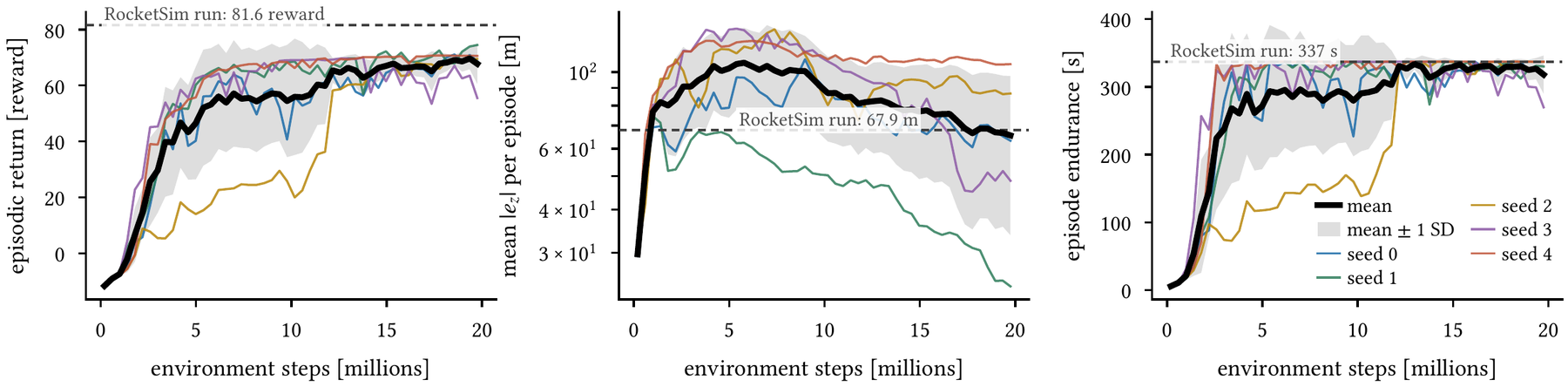
Training is quick to show progress. Return and flight time converge across five seeds, so by those measures all five agents are equally good. The altitude error does not converge: it fans out from 24 m to 105 m. Runs that score the same hover four-fold apart, because the reward does not pin down where to hover.
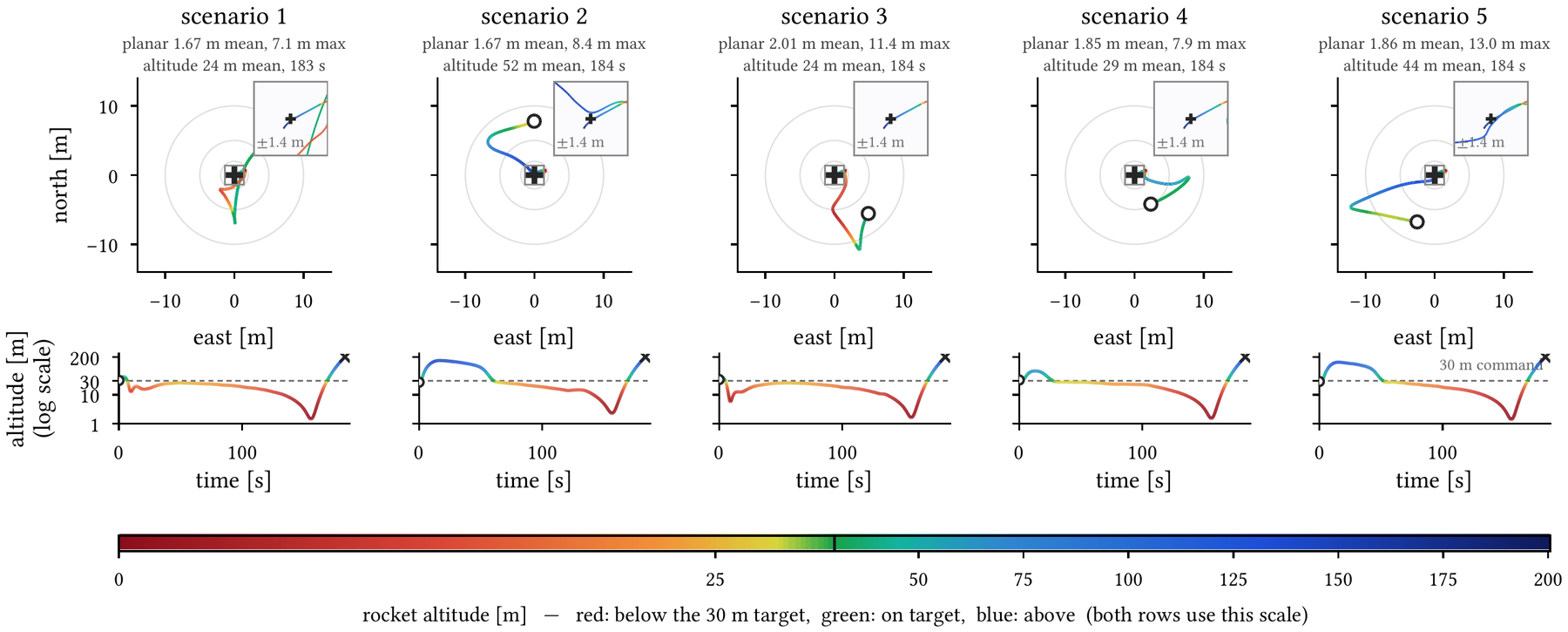
After training, the rocket flies steadily over the pad, within about 3 m of it and 2° of vertical, yet spends only about a fifth of each flight within 5 m of the commanded height. Which way an agent misses depends on its seed: over 200 episodes each, one of the five agents reaches the ceiling in 179 episodes, three run into the ground, and one burns its fuel 107 m above the target.
Why: two separate causes
1. The reward gives PPO nothing to follow far from the target
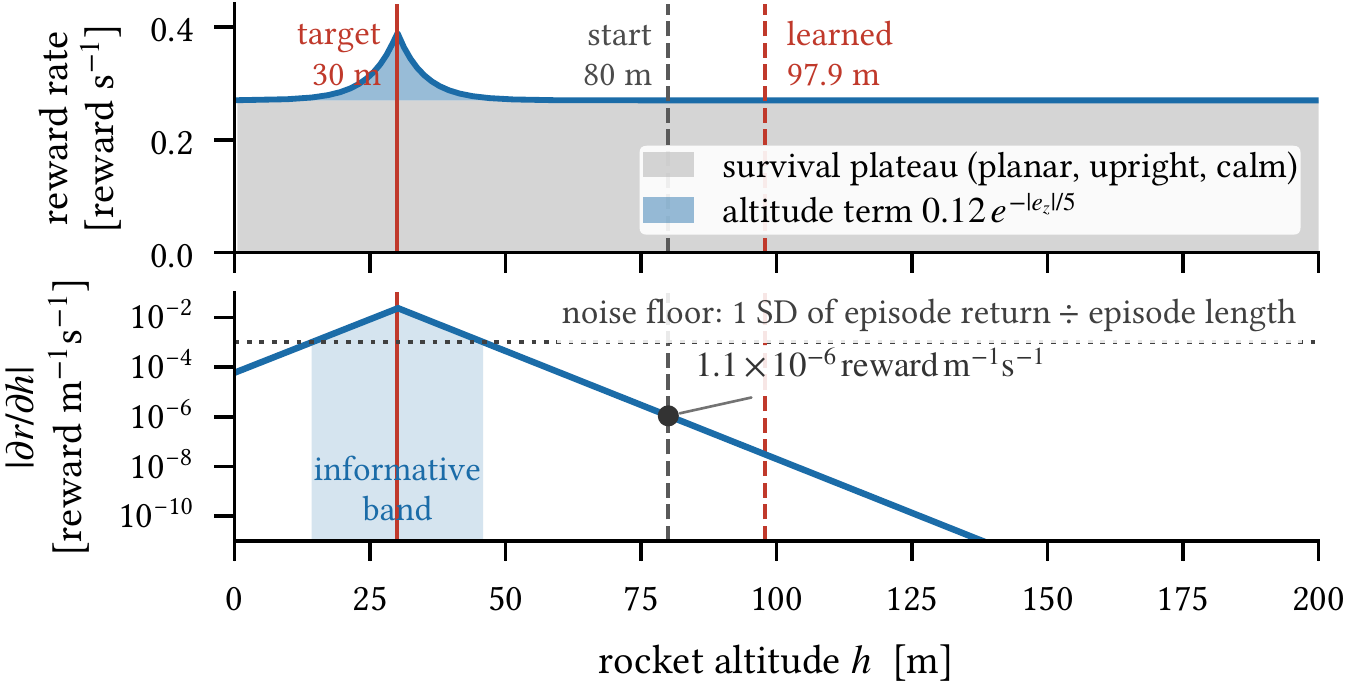
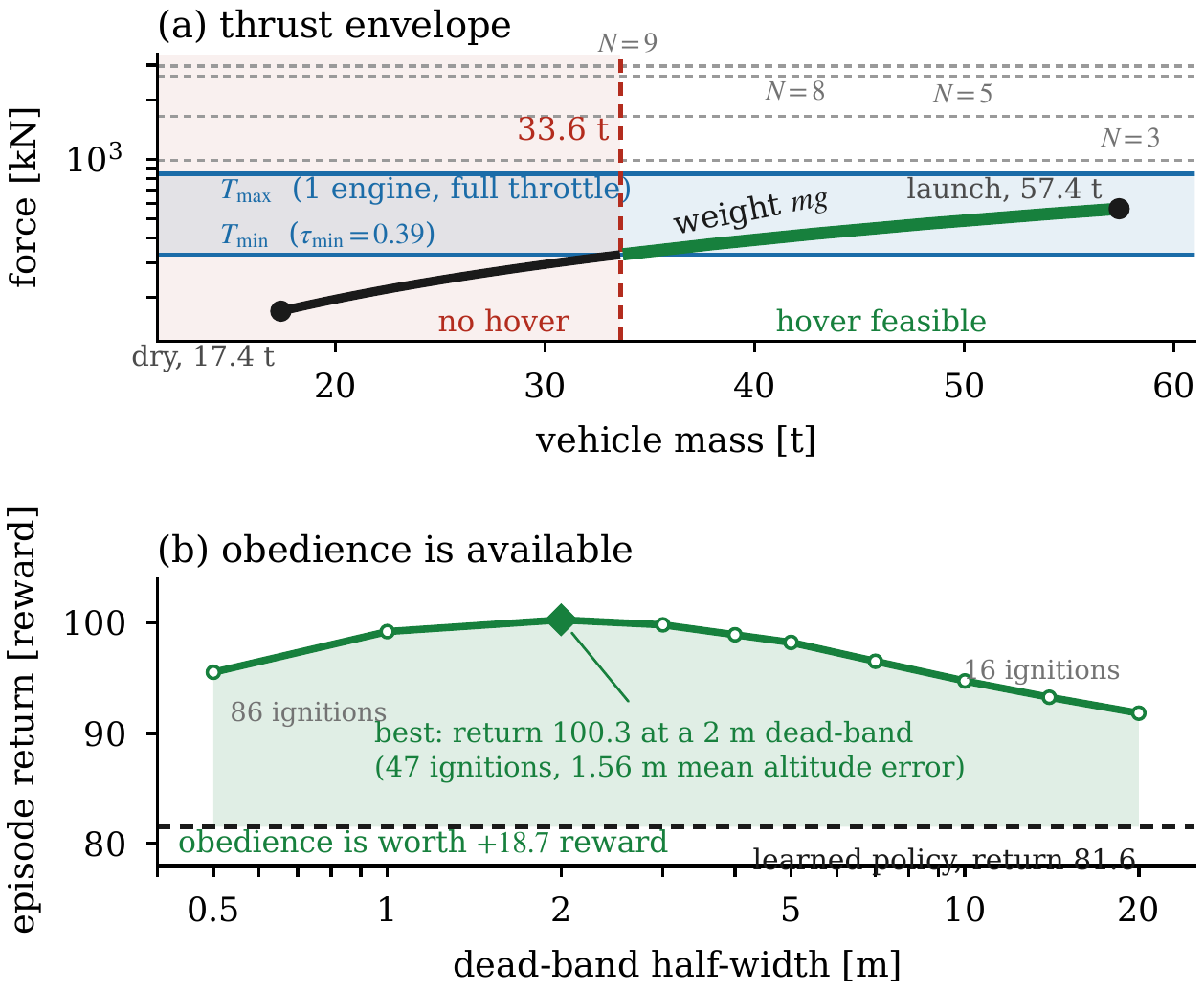
The reward already prefers obedient flight. A hand-written controller that switches the engine on and off to hold the height scores 100.3, against 81.6 for the learned agent, for every tolerance the authors tried. So the objective is not mis-ranked. It is uninformative: the reward is a flat plateau for merely surviving, with a narrow spike at the target height. Released 50 m away, the agent sees a height signal about a thousand times smaller than the ordinary run-to-run noise in its score, so there is nothing to climb.
2. For the last 55% of the burn, hovering is physically impossible
A burning rocket gets lighter and needs less thrust, but this engine cannot throttle below 39%. Once the vehicle weighs less than 33.6 t, even the lowest thrust exceeds its weight, so it can only climb. That happens 151 s into a 337 s burn. No other engine configuration helps: three or more engines raise the lightest hoverable mass to 100.8 t or beyond, well above the 57.4 t launch mass.
Attempted fixes
The paper tests four repairs. Three reshape the objective: a wider altitude term, a release inside the target band, and potential-based shaping that pays for progress toward the target everywhere. All three beat the configured reward, and potential-based shaping is best, reaching a 6 m mean final error against 36 m in 4.6 million steps instead of 8.5 million. Each still strands one or two seeds, and re-weighting alone does not help: a tenfold heavier altitude term still leaves a gradient of order 10−5 at launch. The fourth repair lowers the throttle floor to 20% so hover is feasible for the whole burn. The climb disappears, and the vehicle sinks instead.
Takeaway. Hover cannot be fixed in one place. The reward needs a gradient everywhere, the vehicle needs throttle authority for the whole burn, and results must be reported over several seeds, because equal scores can hide four-fold different behaviour. These are the open challenges the benchmark sets for future work.
Scope
The physics equations are standard textbook models. The model leaves out structural flexibility, propellant slosh, plume–ground interaction and sensor noise, and it is not calibrated against flight data: it is an algorithmic simulation, not a trajectory predictor. Multi-seed experiments use a faster three-degree-of-freedom reproduction of the task that matches the full RocketSim run's endurance to 3%, so that numbers across seeds are comparable. The authors found no earlier published RL benchmark for booster hover, so the numbers cannot be ranked against previous results.
Code
The paper states that RocketSim and the analysis code will be released open source on this site. That release is not yet online; this page will link to it when it is.
Cite
@inproceedings{ghosh2026rocketsim,
  author    = {Ghosh, Swarnendu and Muhi{\v c}, David and {\v S}ter, Branko},
  title     = {{RocketSim}: Benchmarking Reinforcement-Learning Hover Control of a Reusable Booster},
  booktitle = {29th International Multiconference Information Society (IS 2026)},
  volume    = {1},
  pages     = {64--67},
  address   = {Ljubljana, Slovenia},
  year      = {2026},
  doi       = {10.70314/is.2026.skui.80}
}