Questioning Post-hoc Image Corruptions as a Proxy for Environmental Variation in Autonomous Driving
Faculty of Computer and Information Science (FRI), University of Ljubljana, Slovenia
29th International Multiconference Information Society (IS 2026), Ljubljana, 5–9 October 2026 · Vol. 1, pp. 60–63 · DOI 10.70314/is.2026.skui.79
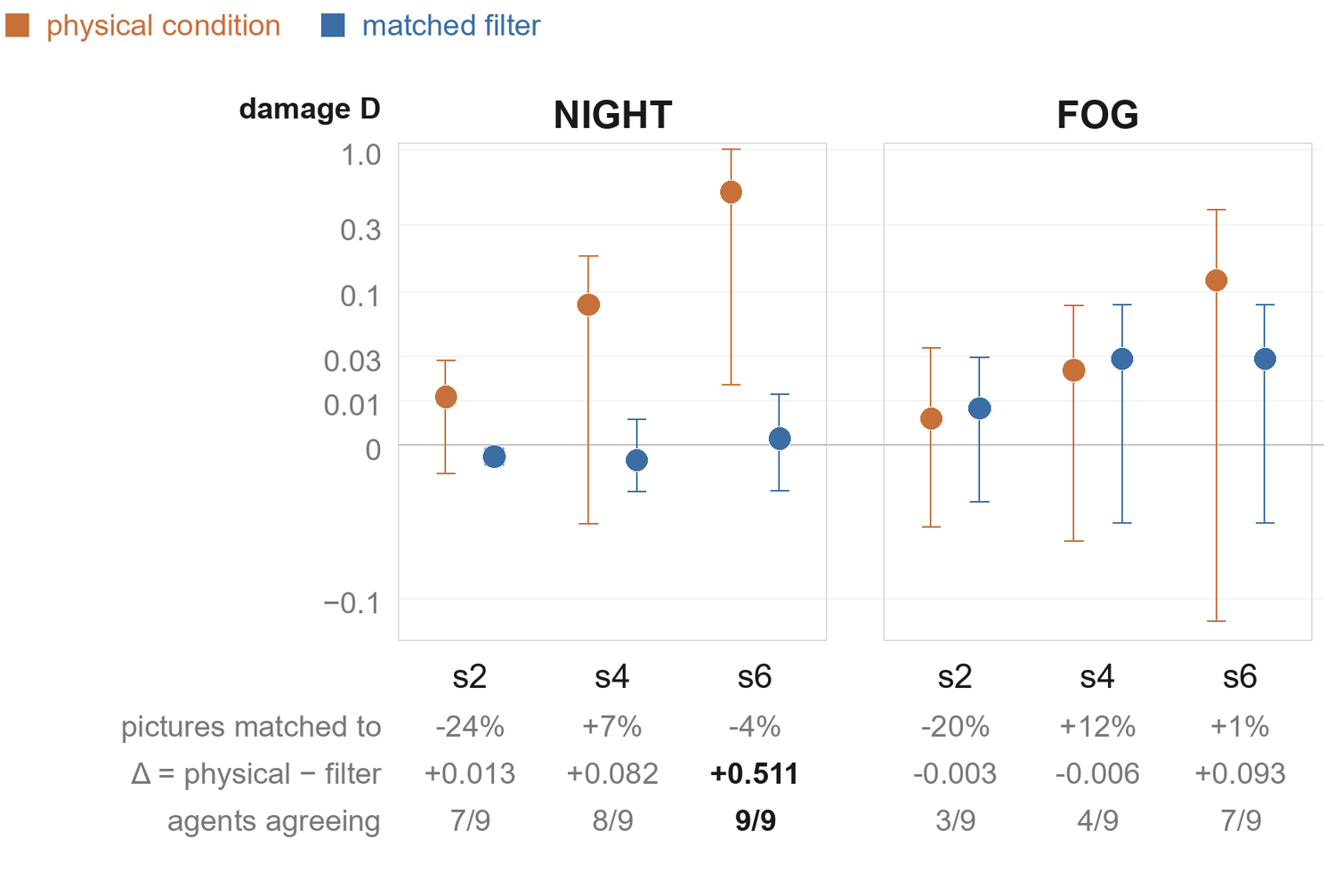
Abstract. Camera-driven cars are usually stress-tested by degrading recorded footage with standard image filters (darkening, fog-like veils) and checking how badly the vision network copes. We show this misleads, and that whether it does depends on the physics of the condition imitated. We take two conditions our simulator produces honestly, a night made by dimming the lights before rendering and a fog made by exponential thickening with scene depth, and match each to the filter named after it on measured picture change. Nine independently trained agents then drive both. Fog is reproduced faithfully at every strength. Night is not: at a picture change of 38 grey levels the physical night costs 0.51 of driving performance and the darkening filter matched to it costs nothing measurable, and all nine agents agree (sign test, p = 0.004). We test the natural explanation, that real weather removes detail by distance while a filter cannot, on 20 CARLA presets with metric depth. The signature is real and separates fog from a depth-blind filter, but nightfall scores as depth-blind itself, and it is nightfall that puts our agents off the road. The asymmetry reappears in training: post-hoc augmentation leaves an agent slightly worse against physical conditions (8.68 laps of ten against 9.05 unaugmented), while re-rendered conditions complete every lap.
Keywords: robustness evaluation, autonomous driving, reinforcement learning, image corruptions, simulation-to-reality gap, CARLA
The short version
A common shortcut for testing a self-driving system is to take clear-weather footage and paint the weather on afterwards with an image filter. This paper asks whether that stand-in is safe, using the measure that matters: does the car stay on the road? For fog, the filter works. For night, it does not, and it fails in the dangerous direction by calling the worst condition harmless.
Same change to the picture, different outcome
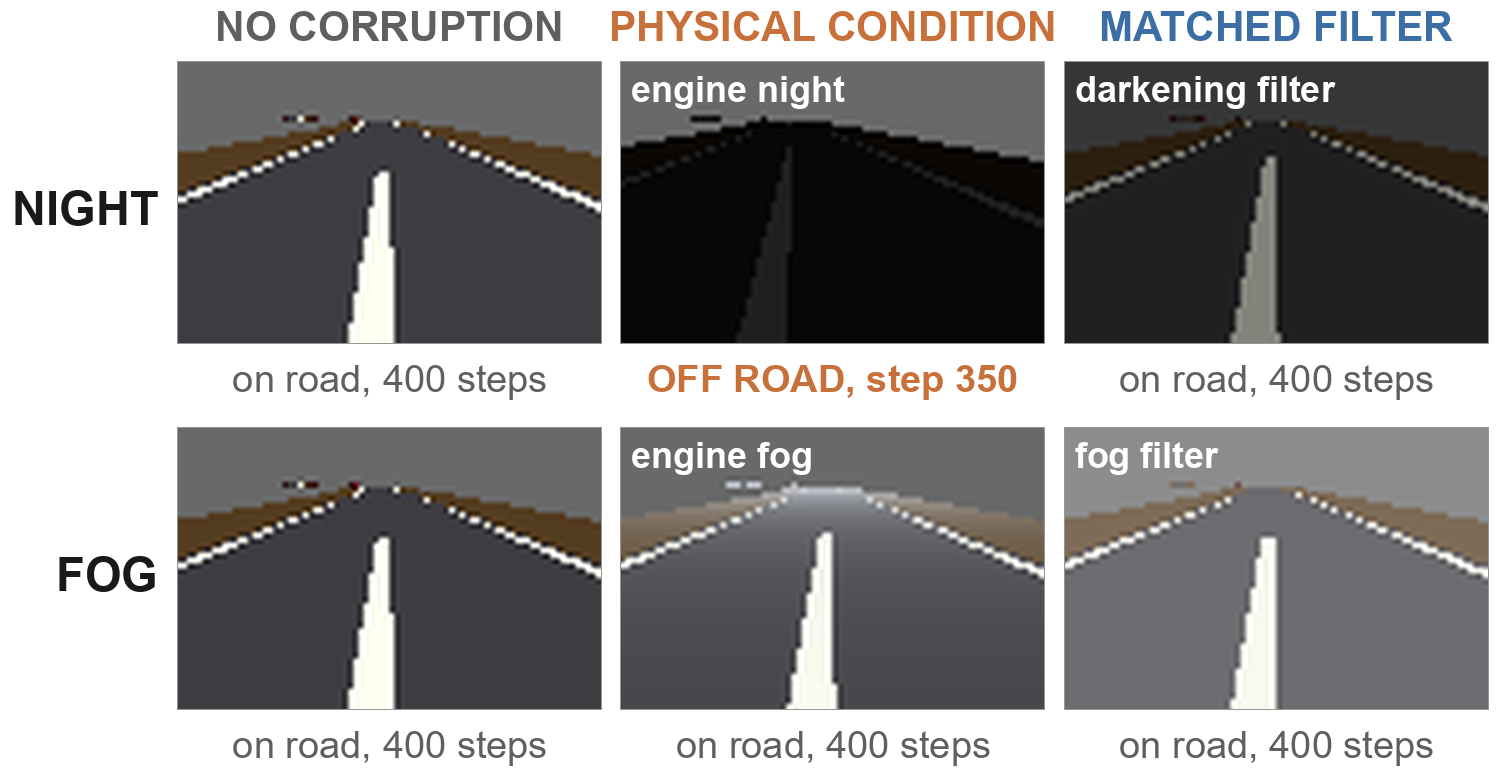
The simulator makes a scene worse in two ways. An in-engine condition changes the world and re-renders it; a post-hoc condition edits the finished frame with one of 14 ImageNet-C style filters. The two were never calibrated against each other, so the paper matches them on measured picture change instead: for each in-engine condition it keeps the strength of the filter whose average pixel change is closest. At the strongest setting the night and its filter both shift every pixel by about 38 grey levels, within 4%.
A distance signature that certifies scattering, not danger
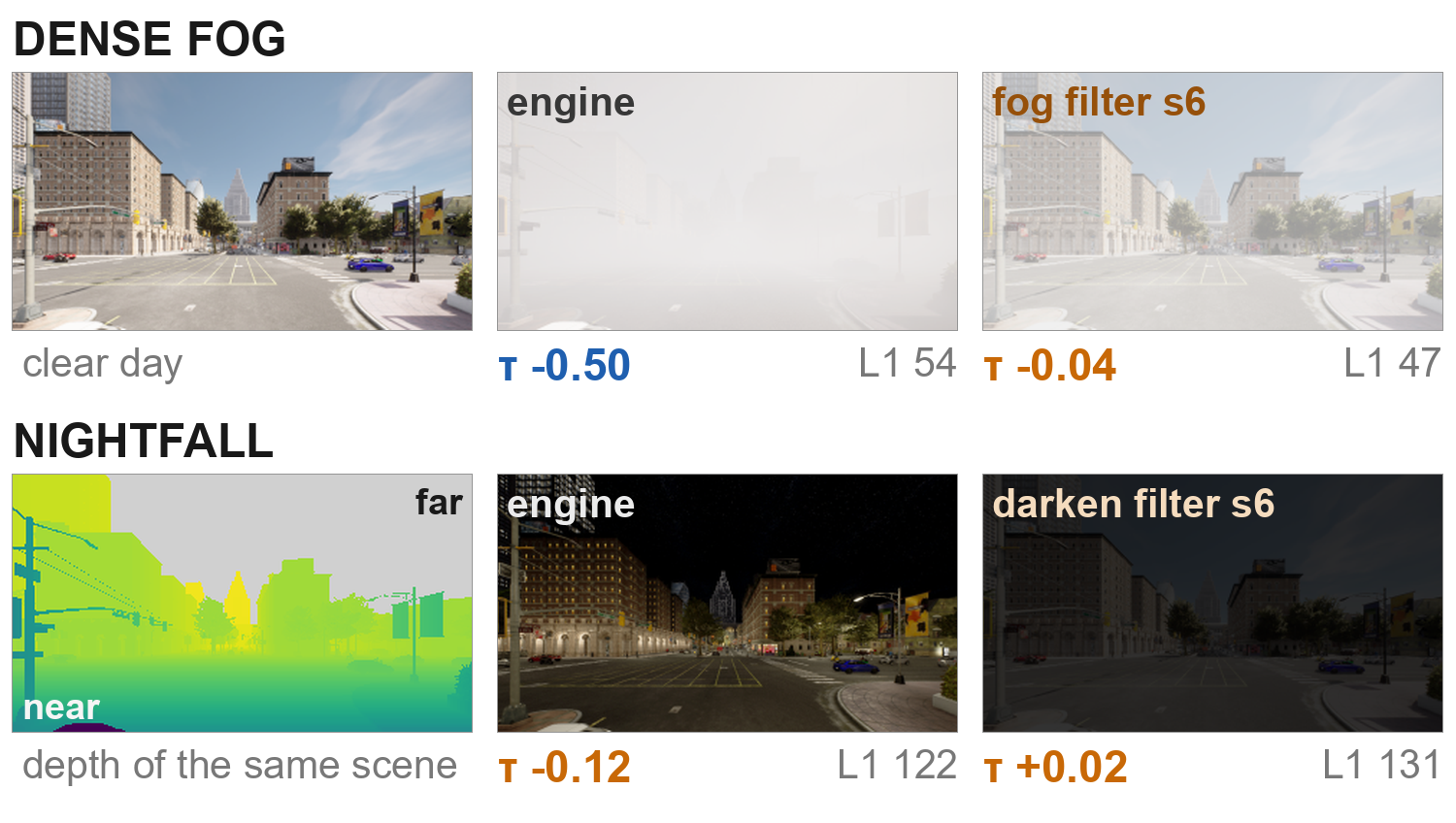
The obvious explanation is that real weather removes detail by distance, while a flat filter cannot. To test it, the paper defines a statistic, τ, that measures whether contrast was lost evenly or more in the far field, after removing everything a distance-blind operator could have produced. It is calibrated on 32 depth-blind operators, which sets an envelope of |τ| ≤ 0.228, then applied to a CARLA capture of 20 weather and illumination presets with a true metric depth channel.
- It works for fog. Dense fog scores τ = −0.504 against −0.040 for the benchmark's fog filter, and the five dense fogs are the only conditions in the capture that leave the envelope.
- It cannot see night. Nightfall scores −0.117 and its darkening filter +0.022, both inside the envelope, even though the night changes the picture more than twice as much.
- Standard fidelity metrics do not help. PSNR and SSIM call the filtered night the more degraded image, yet it is the engine night, not the filter, that does all the driving damage.
- The mechanism is retracted. Depth-blindness is not why the filters mislead. Across all 42 condition–strength pairs the renderer can produce, how strongly a condition strips the far field correlates with damage at ρ = +0.506, backwards for the explanation. The paper keeps the measurement and drops the explanation.
Does augmenting with filters fix it?
On a closed ten-lap circuit, three training regimes were compared, two converged seeds each: clean images only; post-hoc filters only; and filters plus re-rendered conditions. Five engine conditions were held out of every regime and used only for testing.
- The clean-trained agent fails reliably under the physical night: 5.19 of ten laps, leaving the road in half of all runs.
- Filter augmentation helps against that particular night (8.37 laps) but not against held-out physical conditions in general: 8.68 laps against 9.05 for no augmentation, so it is slightly worse.
- The regime that also saw re-rendered conditions is best on every held-out physical condition, completing all ten laps in both seeds.
Training on filters buys robustness mainly to filters. What transferred was having seen the renderer change the world, not the picture changed afterwards.
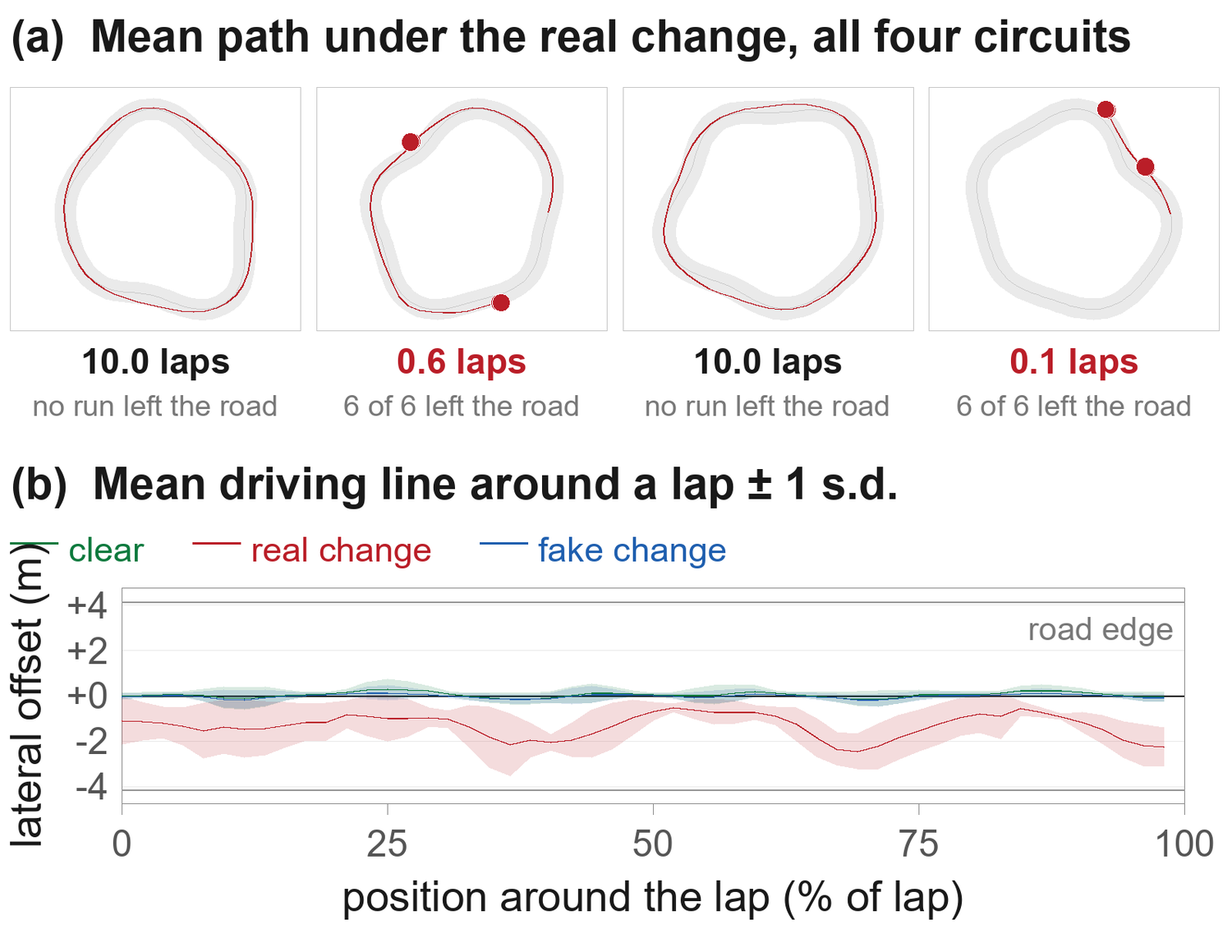
Takeaway. Manufacturing weather with filters fails selectively, which is worse than failing outright. A practitioner screening with the darkening filter would file the most dangerous condition tested as the safest, and a screen that passes on fog gives no assurance about night.
Scope
These are simulator measurements. The CARLA part establishes a correspondence in image statistics, not in driving, and the in-engine conditions are approximations: the panda3d fog is not scattering physics, and the night has no headlights, which plausibly overstates what darkness does to a lit vehicle. Nine agents with a thirty-four-fold spread in fragility, and two converged seeds per regime, leave the closed-circuit comparison an indication rather than a proof. Two directions follow: τ is blind to a change of illumination, which leaves absolute luminance as the likeliest remaining explanation and a testable one; and end-to-end architectures with a full CARLA closed loop would test whether the asymmetry survives a real perception stack.
Cite
@inproceedings{ghosh2026posthoc,
  author    = {Ghosh, Swarnendu and {\v S}ter, Branko},
  title     = {Questioning Post-hoc Image Corruptions as a Proxy for Environmental Variation in Autonomous Driving},
  booktitle = {29th International Multiconference Information Society (IS 2026)},
  volume    = {1},
  pages     = {60--63},
  address   = {Ljubljana, Slovenia},
  year      = {2026},
  doi       = {10.70314/is.2026.skui.79}
}